


Taking the DJI Osmo Pocket 4P into a War Zone

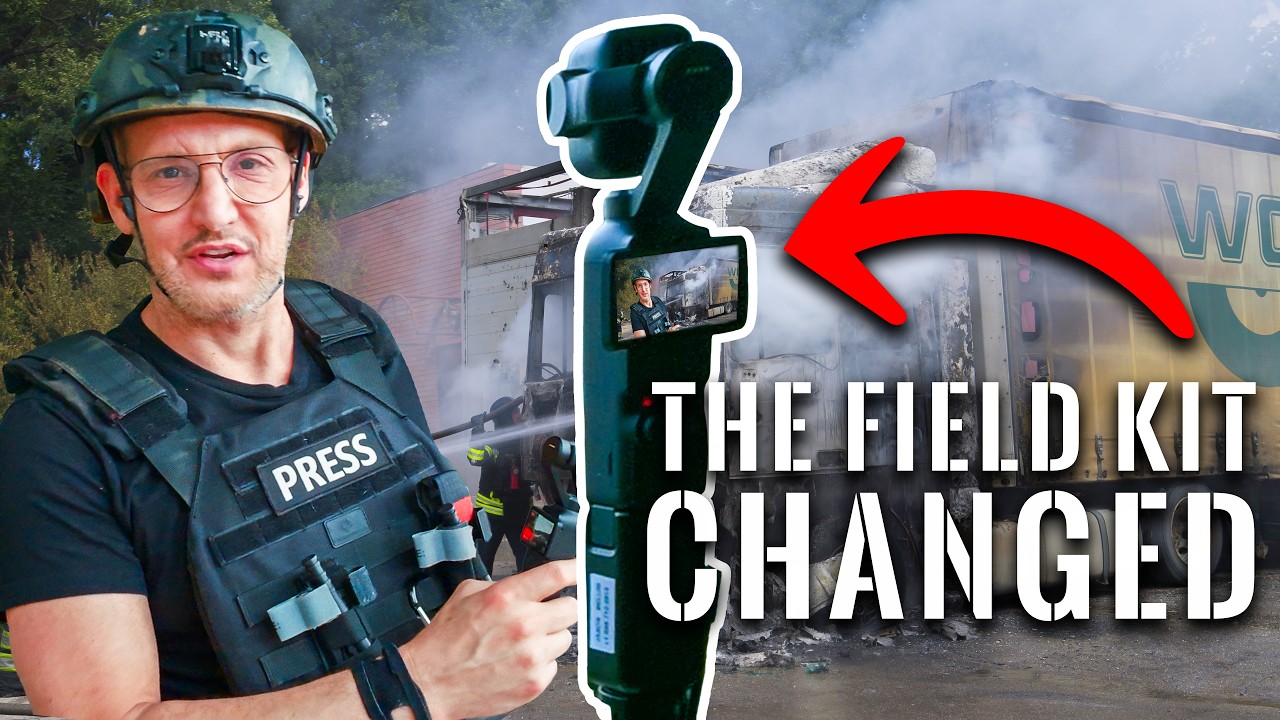
Gone are the days when news and current affairs were captured using traditional 2/3″ broadcast ENG cameras. These days, especially in war zones and other difficult filming environments, a lot of news crews have shifted to mirrorless hybrids, camcorders, GoPros, Osmo Pockets, etc., or a collection of all of the above.
The DJI Osmo Pocket 4P is certainly a camera that could be used for certain shooting situations for news, especially because of the dual lens system. Historically, the usefulness of these cameras was limited due to them only offering a wide-angle perspective.
Recently, Jason Bellini, Scripps News’ Chief International Correspondent, Dateline: Kyiv, Ukraine, got in contact with me after using the new DJI Osmo Pocket 4P.
Here is what he told me:
I’ve long harbored the fantasy of jetting off to cover a major story and carrying in just my backpack all the gear I need for doing live shots and filming short- and long-form pieces. That’s why, after the Osmo Pocket 4P was released in China in June, I needed to get my hands on two of them.
-
Scripps’s Jason Bellini and Noosphere’s Anna Conkling in Kharkiv -
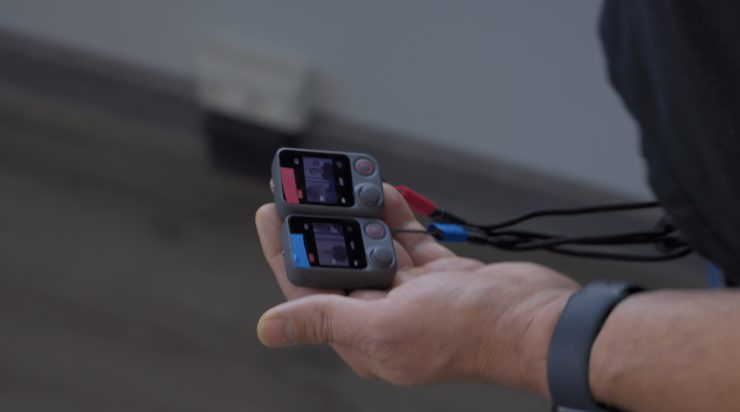
Controlling two 4Ps during an interview using the monitor/ joysticks
I got two to see how they would perform if they were the only cameras I used for some two-camera interviews, which I would otherwise film with Sony FX3s. They also needed to be the “vlogger” kit, which includes the tiny monitor-joystick device, so I could check my framing with a quick look down at it between questions.
One of the big, I think biggest, new features of the 4P is the 3x lens. It really gives you a decent focal length for interviews.
-
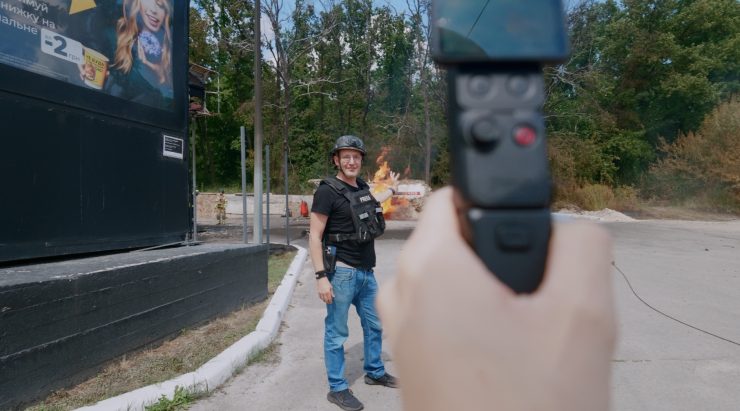
Using the Osmo Pocket 4P on scene of a fiber optic drone attack on a gas station in Kharkiv, Ukraine
Here in Ukraine, I didn’t have the nerve to conduct that only-Osmos experiment on any important interviews. Then, an on-the-fly opportunity arose. Two minutes of setup time, max. I locked my two 4Ps on my subject’s face and mine and gave it a go.
The results were pretty good. Not as good, of course, as my Sonys with their prime 85mm lenses. Nonetheless, airworthy.
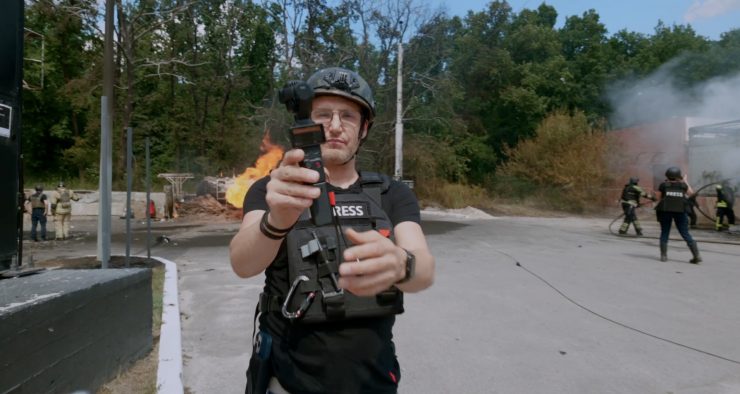
Where it really shone was run-and-gunning. If you’re handing it off to a producer or a fixer, they need to learn to use the AI face and object tracking. And I wouldn’t trust anyone but myself right now to set the white balance and ISO manually. For that matter, when filming in bright sunlight, I don’t really trust myself to get the exposure right. I got it wrong a few times. Even while shooting in Log, I filmed some material that was unusable. To get serious with the 4P, you’ve really got to become a ninja with clip-on ND filters. I’m still like a yellow belt.
Would I connect it to my TVU pack and do a selfie live shot with it? Definitely. Surprisingly enough, this Osmo iteration does play nicely with HDMI connections. I tested it with our tech ops folks. I’ll give that a try sometime soon, no doubt.
As a camera that a producer can pick up and film some B-roll and do some B-cam work, the 4P is no doubt good. But I think the 4P only becomes a serious camera when it’s in the hands of someone who takes seriously learning how to use it properly.
