


Intreprid Makers: Garry Knox Bennet


Like Judy McKie and Wendell Castle, Garry Knox Bennett arrived in woodworking after attending art school and never received formal training in the craft. Also like them, he had a brain teeming with unusual ideas and an enormous drive to get things made.

Drawing was second nature to Bennett, but he didn’t waste time with it before making a piece of furniture. “I don’t do any drawing except right on the wood, at the bandsaw,” he said. He could see his pieces before he made them. “I work out most of my designs at night instead of counting sheep. Then I come into the shop the next day and start sawing.”
He made nearly all his work on speculation and in series. He would choose a furniture form—the chair, the clock, the bench, the dining table—and make a dozen, two dozen, three dozen of them in a stretch, each one different. The pieces in a series might have a shared structural approach, but the finished pieces would look nothing alike. His series of trestle tables, for example, all had thin, light tops and heavy bases, and the same sophisticated techniques he devised for attaching and supporting the tops and for joining the trestle assemblies were applied to many of them. But the exuberant shaping of the trestles, and the colors, textures, and materials he used varied wildly. The shared structural approach enabled him to work at a breakneck pace; when building his trestle tables he was making one per week.
Bennett’s work can be off-putting. Stuffed with ideas and always exclamatory, it strikes some as bombastic and ungainly. That’s the way I felt about much of it when I had seen it only in photos. Then I attended a large show of his work and found that in person the same pieces could be delightful. The range of materials and the dexterity with which he employed them were a revelation. The work was rich with detail that could read as busy from afar but beautiful up close.
Bennett was a provocateur; although plugged into the furniture world, he was determined not to play by its rules. His work drew on traditional furniture forms, structures, and joinery, but it was never enslaved to them, and he often made sport of the worshipful attitude toward wood and traditional craftsmanship that he saw around him. When his Nail Cabinet ran on the back cover of Fine Woodworking in 1979, it ignited a fire in the editor’s inbox and led to quite a few canceled subscriptions. Bennett had built a display cabinet in padouk—decorous and dovetailed—and then driven a carpenter’s nail into one of its doors. “I wanted to make a statement,” he said. “I think tricky joinery is just to show, in most instances, you can do tricky joinery.” His provocation might have succeeded too well. Decades later, having made thousands of pieces of furniture that were bursting with creativity (and not a little tricky joinery) and that sold widely and wound up in museums, he kept hearing about one particular piece. “I’m sick of the Nail Cabinet,” he said.

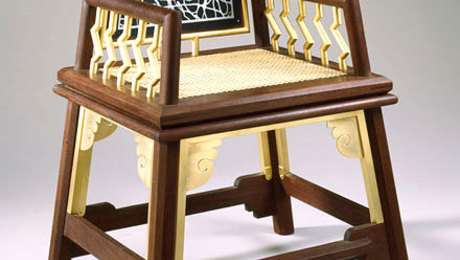
Working with Mixed Media
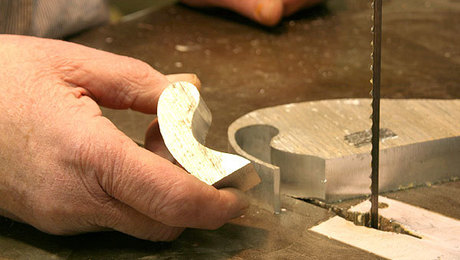
Cut Aluminum on the Bandsaw
Building Garry Bennett’s Trestle Table: Inlay and Wrap-Up
Fine Woodworking Recommended Products

Sketchup Class
If you’re ready to jump into designing with CAD, this is a great place to start.

French Curves
An essential for drawing and designing with curves.

Drafting Tools
Add a hole guide to this kit, and you’ll have the tools you need to work out your designs with scale drawings.
Sign up for eletters today and get the latest techniques and how-to from Fine Woodworking, plus special offers.